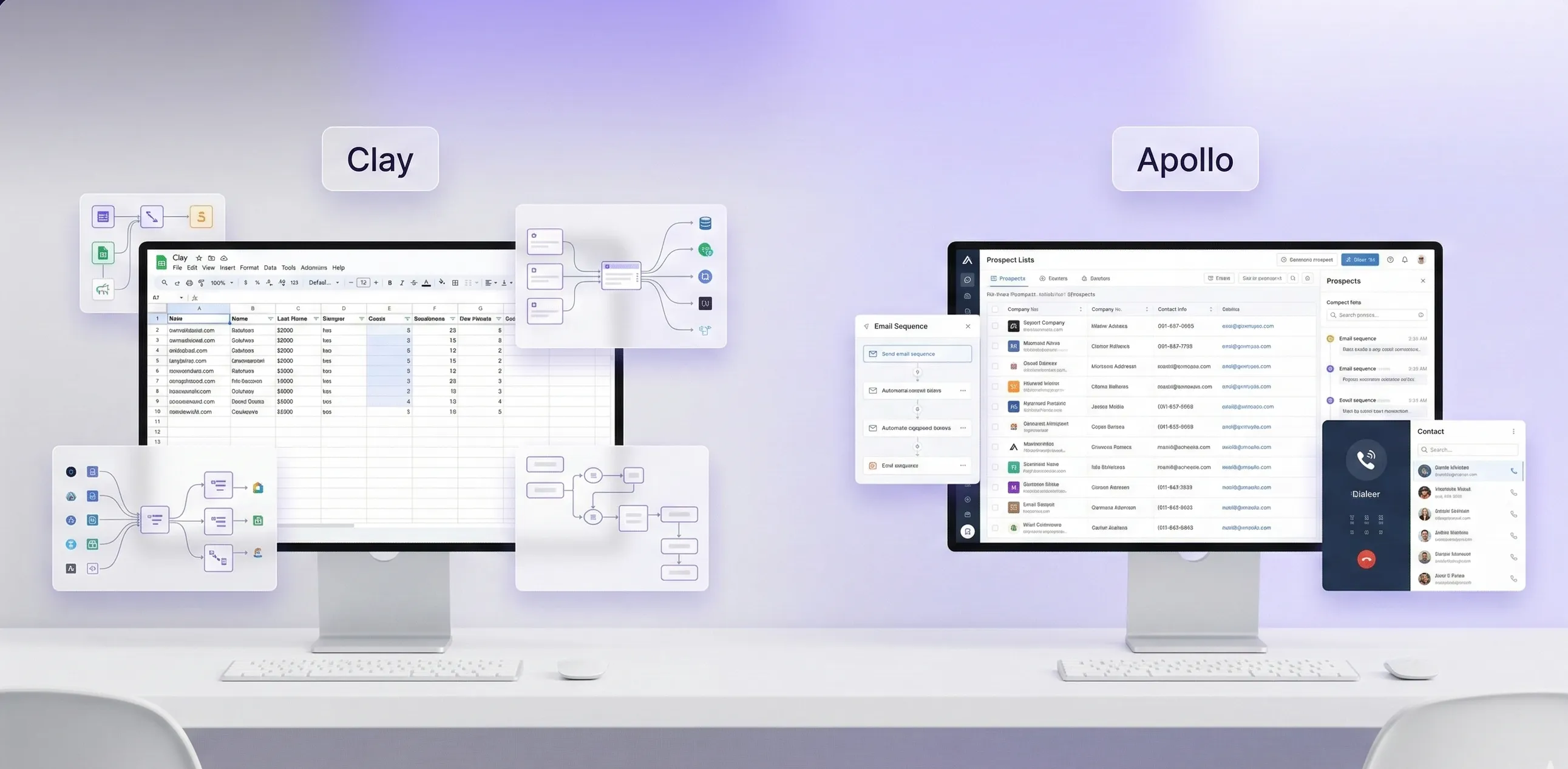

Clay and Apollo both serve revenue teams, but in different ways. Clay focuses on building custom, engineer-friendly data enrichment pipelines with flexibility and integration-first capabilities. Apollo offers an all-in-one sales engagement platform combining prospecting, automation, and enrichment.
Comparing Clay vs Apollo helps founders, SDR leaders, RevOps, and marketing ops teams understand whether they need a highly programmable, developer-focused platform or a full sales engagement suite to drive pipeline and outreach.
Key Takeaways
Apollo serves as an all-in-one engagement platform for teams that need to find leads and run outbound sequences in a single workspace. It is designed for sales reps who want an integrated database and dialer to manage their daily prospecting without switching between different tools.
Clay serves as a programmable data layer for teams that need to aggregate information from multiple providers simultaneously. It is the preferred choice for growth engineers who want to build custom, automated enrichment pipelines that pull specific details from across the web into a centralized spreadsheet.
FullEnrich bridges the gap that both leave behind, where Apollo’s internal database might be outdated, or Clay’s multi-provider setup becomes too complex to manage.FullEnrich solves this by triggering a real-time "waterfall" search across 20+ premium vendors.
Clay vs Apollo: Side-by-Side Comparison
Let’s look at this quick comparison to understand how Clay and Apollo differ in their service models, automation, pricing, and ideal use cases for modern revenue teams.
Attributes | Clay | Apollo |
|---|---|---|
Best For | Technical growth teams and engineers building custom enrichment pipelines | Sales, SDR, and marketing teams need an all-in-one engagement & prospecting platform |
Core Focus | Programmable, spreadsheet-based orchestration layer | Combined prospecting, engagement automation, and data enrichment |
Primary Users | Developers, RevOps engineers, data-focused GTM teams | SDRs, sales leaders, marketing ops, and growth teams |
Data Source | Aggregated public datasets and multiple provider integrations | Aggregated B2B datasets with proprietary enrichment algorithms |
Automation | High; programmatic workflows and API-driven enrichment | Moderate; engagement sequences, emails, and call automation included |
Pricing Model | Usage-based API pricing starts around $134 per month (billed annually) | Subscription-based; starts at $49 per user/month (billed annually) |
Integration | Flexible API integration with CRM, data warehouses, and analytics tools | CRM integrations (Salesforce, HubSpot), email, and engagement tools |
Data Compliance | GDPR and CCPA are aligned | GDPR and CCPA are aligned |
Support | Developer documentation, API support tickets, and enterprise support | Email, chat support, knowledge base, dedicated account managers on higher tiers |
What is Clay?
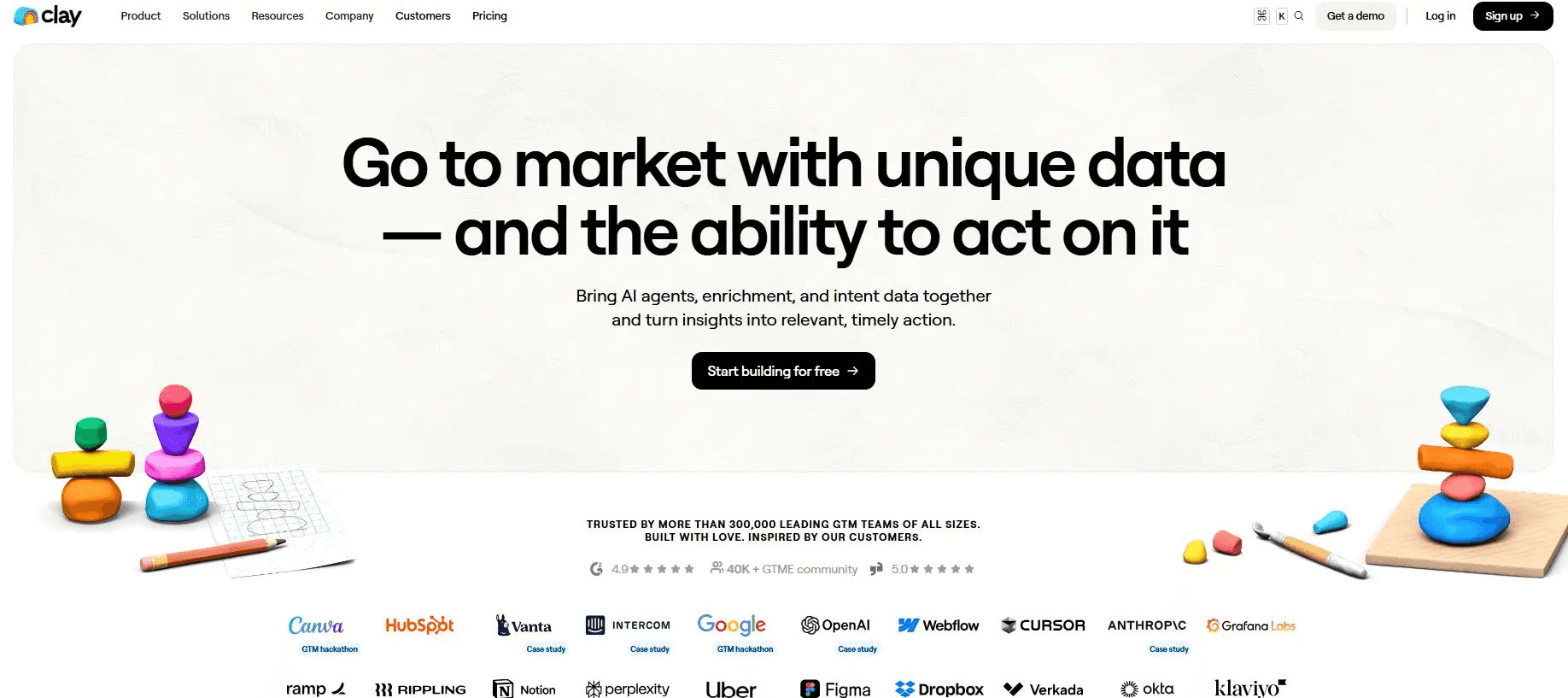
Clay is an API-first, developer-friendly platform that enables teams to build custom data enrichment pipelines and integrate multiple B2B data sources. It focuses on flexibility, allowing technical growth teams and RevOps engineers to automate enrichment workflows, normalize data, and push clean data into CRMs, analytics tools, or internal dashboards.
What is Apollo?
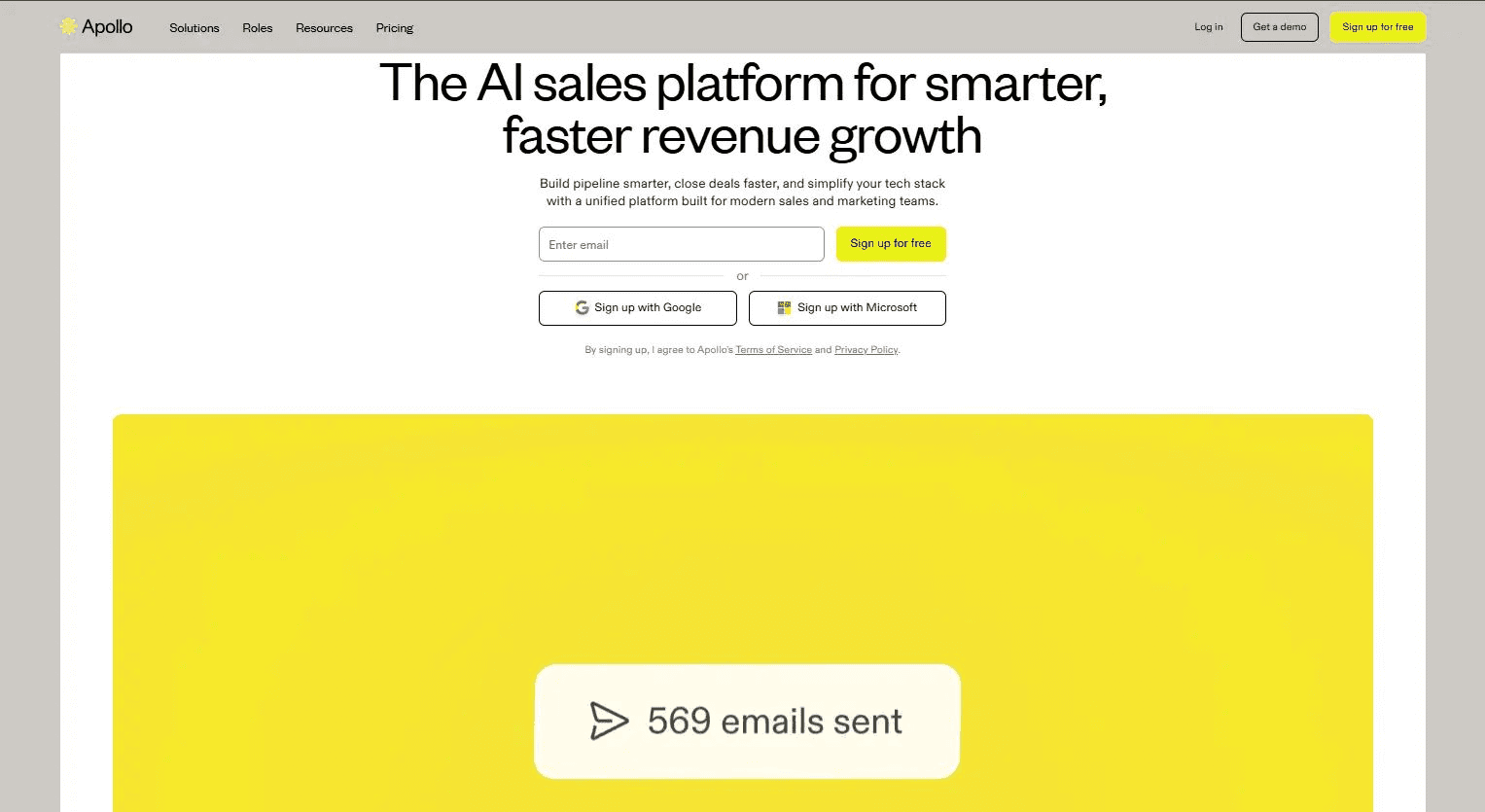
Apollo is an all-in-one sales engagement and prospecting platform designed for SDRs, sales leaders, and marketing ops teams. It combines B2B prospecting, engagement automation, and contact/company enrichment in a single SaaS platform. Apollo allows users to build sequences, automate outreach via email and calls, and manage CRM integration for pipeline visibility.
What Services Are Offered by Clay and Apollo?
Clay and Apollo serve B2B teams differently. Clay provides a technical, API-first approach for building enrichment pipelines, while Apollo delivers an all-in-one sales engagement platform with prospecting and automation capabilities.
Services Offered by Clay
Clay operates as a specialized "data orchestration" engine, functioning more like a technical bridge than a standard contact list. It doesn’t just give you data; it provides the infrastructure to pull, verify, and clean it from over 100 different providers simultaneously.
Waterfall Data Enrichment Service: This is Clay’s most powerful service. Instead of relying on a single database, Clay sequentially queries multiple providers (such as Apollo, Hunter, and DropContact) until it finds a verified result.
AI-Powered Lead Research (Claygent): Clay provides a dedicated AI "research assistant" service that browses the live web as a human SDR would. It can visit company websites, read their "About Us" pages, and summarize their specific product offerings or recent press releases into short, actionable snippets for your team.
Automated Data Cleaning & Normalization: This service acts as a "digital editor" for your lead lists. It automatically fixes common data issues, such as converting ALL CAPS job titles into a professional format, removing emojis from names, and ensuring all company names are cleaned of "Inc." or "L.L.C."
Services Offered by Apollo
Apollo is an all-in-one "sales engagement" engine designed to manage the entire sales lifecycle, from the first search to the final meeting. While other tools focus solely on the data, Apollo provides the machinery to execute outreach.
B2B Contact & Account Discovery: Apollo provides a massive, built-in search service that gives you access to over 275 million professional contacts. It functions as a high-speed search engine for the business world, allowing you to filter for active buyers by department, seniority, and even recent company growth.
Multi-Channel Outreach Service (Sequencing): This service manages the actual "sending" of your sales messages. It allows you to build a complete outreach schedule that includes automated emails, LinkedIn connection requests, and manual call tasks.
Integrated Cloud Dialer Service: Apollo provides a professional phone service built directly into the browser. This allows sales reps to make, record, and log calls instantly. It includes "parallel dialing" services that can dial multiple numbers at once to save time and connect you with a live human faster.
Buyer Intent & Signal Monitoring: This service tracks "digital footprints" across the web to tell you which companies are currently looking to buy. It monitors hiring trends and technology changes.
What Are the Key Features of Clay and Apollo?
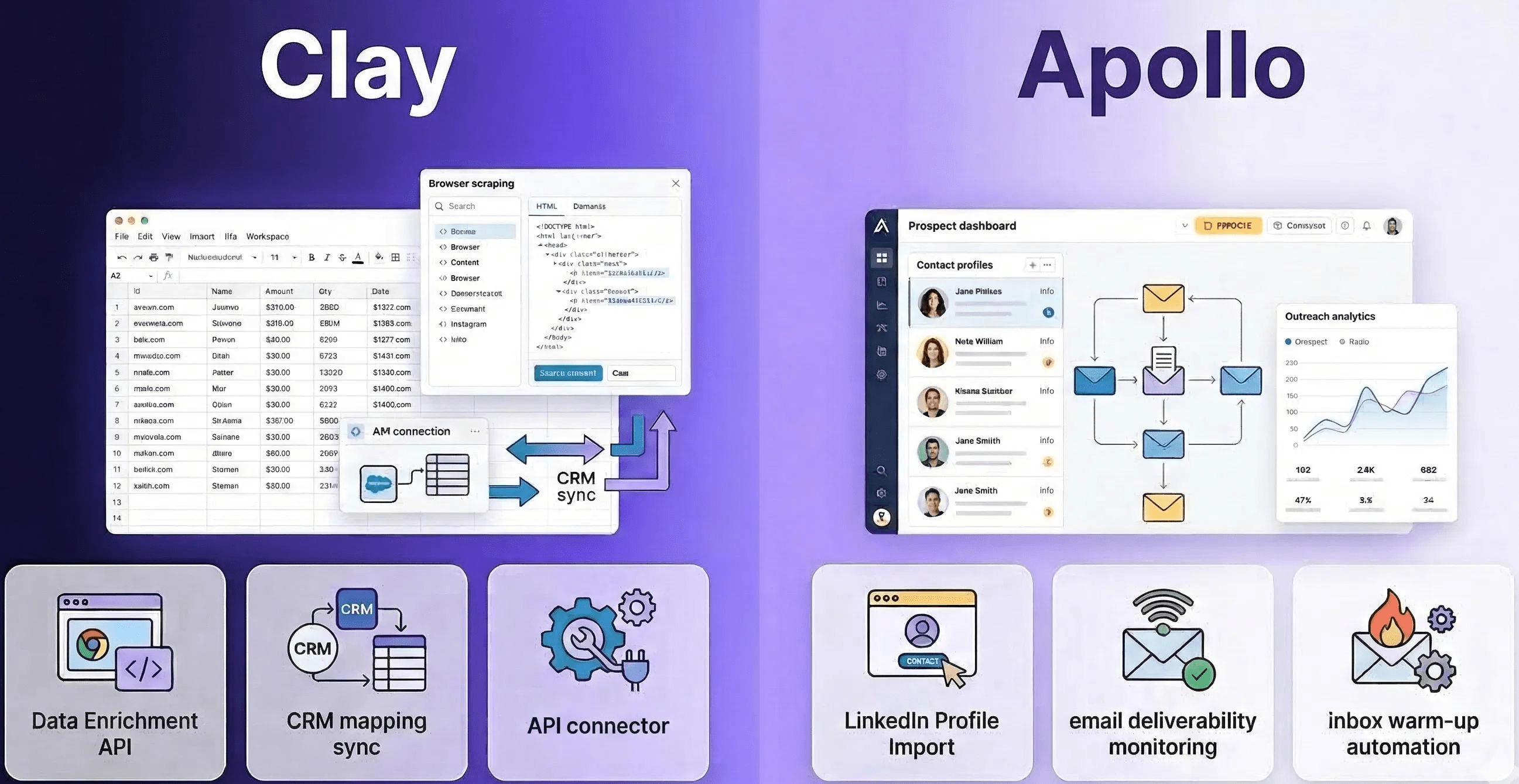
Key features highlight the platform-level capabilities that differentiate Clay and Apollo. Clay focuses on flexibility, API integration, and scalable enrichment workflows, while Apollo emphasizes sales engagement, automation, and built-in prospecting tools.
Key Features of Clay
Clay’s features are all about giving you a "developer’s grip" on data without making you write code. It’s built for the person who wants to engineer a specific outcome rather than just buy a list.
Clay for Chrome (Scraping & Recipes): This isn't just a simple lead-finder; it's a powerful web scraper built into your browser. It allows you to extract structured data such as tables, lists, and technical site information directly from any website. You can build "recipes" to automatically map specific attributes (such as company size or technologies used) from similarly structured pages and port them directly into your Clay table.
Bi-directional CRM Mapping: Unlike a simple export, Clay features a live sync that can read your Salesforce or HubSpot fields and then "update only if empty." This ensures your automated research never overwrites the manual notes your sales reps have already spent hours writing.
HTTP API Connector: This feature turns Clay into a "universal plug." If a data source has an API but doesn't have a "native" integration yet, you can still plug it in yourself. This gives you a level of technical freedom that standard databases simply don't allow.
Key Features of Apollo
Apollo is built for speed and high-volume execution. Its features are designed to remove the "friction" between finding a person and getting them on the phone.
The Apollo Chrome Extension: This feature lives on top of LinkedIn and company websites. It allows you to "reveal" a person’s phone number or add them directly to a sequence while you are browsing their profile, effectively bringing the database to where you already work.
Deliverability & Warm-up Suite: Apollo includes a backend feature set designed to protect your email reputation. It handles "inbox rotation" and automated "warm-ups," making sure that when you send 500 emails, they actually land in the inbox instead of the spam folder.
How Accurate Is the Data from Clay and Apollo?
Data accuracy determines pipeline quality, campaign success, and enrichment reliability. Clay and Apollo approach accuracy differently: Clay emphasizes programmatic multi-source enrichment, while Apollo combines proprietary algorithms with internal validation for sales engagement.
Clay Data Accuracy
Clay doesn't actually "own" a single database; instead, it acts as an aggregator, pulling data from over 75 providers. Because of this, its accuracy isn't a fixed number but rather a result of its "waterfall" process. If one source has an outdated email, Clay simply moves to the next one in line until it finds a hit that passes a real-time verification check. This layer-by-layer approach is why many users on G2 consistently rate Clay 4.7/5 stars, specifically noting lower bounce rates than with a single-source tool.
Apollo Data Accuracy
Apollo works differently because it maintains its own massive internal database of over 275 million contacts. In a real-world setting, most teams find that while Apollo is incredible at quickly finding a high volume of leads, the actual accuracy for direct dials and emails usually sits between 70% and 80%. It’s a trade-off: you get instant access to millions of people at a very low cost, but you have to expect a certain percentage of those records to be a few months behind the curve.
Also Read: 15 Best Apollo Alternatives & Competitors
Which Platform Offers the Most Intuitive User Experience?
User experience is a key differentiator between Clay and Apollo, as it directly impacts adoption, workflow efficiency, and team productivity. Clay is a developer-focused, API-first platform that prioritizes flexibility and programmable enrichment, while Apollo is a ready-to-use sales engagement tool built for SDRs, sales leaders, and marketing teams
Clay User Experience
Clay provides a self-serve platform where users primarily interact via API endpoints and dashboards. Developers and RevOps engineers set up enrichment pipelines, configure triggers, and push data to CRMs or analytics tools. Onboarding involves API key management, workflow setup, and dataset integration. Non-technical users may find the platform complex, but the flexibility allows highly customized workflows and multi-provider enrichment.
Apollo User Experience
Apollo offers a straightforward SaaS interface with dashboards, sequences, and prospect lists. Users can create email or call campaigns, prioritize leads, and track engagement metrics without coding. Onboarding includes CRM integration, contact import, and sequence creation. The platform is designed for SDRs, sales leaders, and marketing teams seeking a plug-and-play experience rather than building custom pipelines.
Pricing and Plans
Understanding pricing helps teams match platform capabilities with budget and scale. Clay uses usage-based API pricing for programmable enrichment, while Apollo uses subscription tiers for sales engagement and prospecting.
Clay Pricing Plans
Clay's pricing is built on a credit system. Every time you ask the tool to find an email, scrape a website, or run an AI search, you use credits. If you have a high-volume month of research, you'll burn through credits faster.
Free Plan: This is a great way to test the "waterfall" logic. You get 1,200 credits per year and can search for up to 200 companies and people. It’s strictly for small-scale testing.
Starter Plan ($134/month billed annually): A solid entry point for small teams. It gives you 24,000 credits per year and allows for 5,000 searches. This is where you start to see the real power of automated enrichment.
Explorer Plan ($314/month billed annually): Designed for growing teams. This bumps you up to 120,000 credits per year and 25,000 searches. This is the tier where most users begin to scale their outbound operations.
Pro Plan ($720/month billed annually): For high-intensity data users. You get a massive 600,000 credits per year and up to 50,000 searches. This is built for teams conducting ongoing, deep research on thousands of leads each week.
Enterprise Plan (Custom): If your volume exceeds the Pro limits or you have a massive team that needs dedicated support and security features, you’ll need to request a quote for a custom contract.
Also Read: Clay Pricing & Plans (2025): Is it Worth it?
Apollo Pricing Plans
Apollo follows a more traditional SaaS model pricing. You pay per user, and while there are credit limits, the focus is on the features you unlock, such as the dialer, sequences, and advanced filters.
Free Plan: A very generous starting point for solo reps. It provides 900 credits per user, per year. It’s enough to get a few leads on the phone each week, with no upfront cost.
Basic Plan ($49/user/month billed annually): This unlocks the core "sales engine" features. You get 30,000 credits per year, which is plenty for a standard SDR who is focused on consistent, daily prospecting.
Professional Plan ($79/user/month billed annually): This is the "sweet spot" for most sales teams. At $79 (or $99 monthly), it provides 48,000 credits and Automated Workflows.
Organization Plan ($119/user/month billed annually): This is the "everything" plan. For $119, you get 70,000 credits per year and access to all the advanced enterprise features, including call recording and advanced security settings.
Who Should Use Clay vs. Apollo?
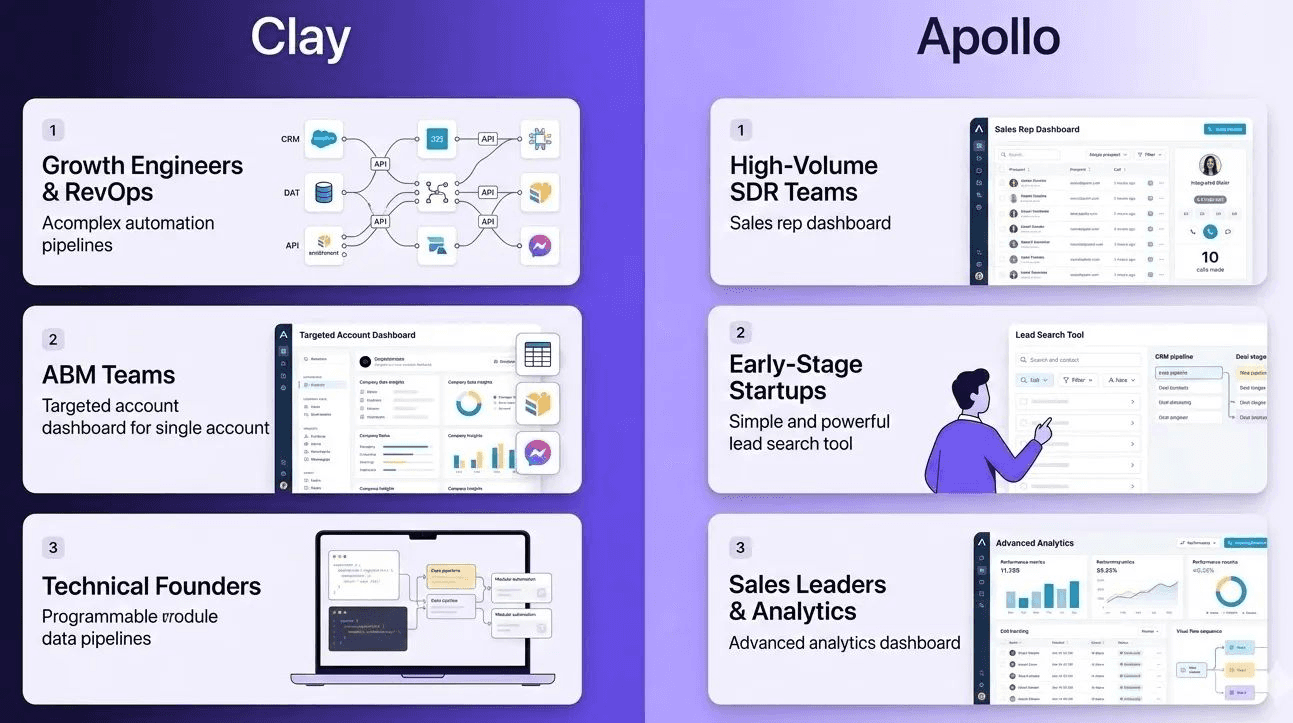
Apollo is designed for the high-volume outreach rep who needs to find a lead and call them in the same minute. Clay is for the growth engineer who wants to pull data from 10 different sources to find a very specific "hook" before they even send an email.
Who Should Use Clay?
Clay is for the teams that have outgrown standard databases. It is built for those who prioritize "quality over quantity" and want to use hyper-personalized data to stand out in a crowded inbox.
Growth Engineers & RevOps: If your job is to build complex, automated workflows that sync data across five different tools, Clay is your playground.
Account-Based Marketing (ABM) Teams: Ideal for those targeting a small list of high-value accounts where you need to know specific details, like what tech stack they use or what their CEO said in a recent podcast.
Technical Founders: If you're comfortable with a bit of "if-then" logic and want to build a prospecting machine that runs on autopilot while you build the product.
Who Should Use Apollo?
Apollo is for the "boots on the ground" sales team. It’s built for speed, efficiency, and keeping your SDRs active and focused on hitting their daily activity quotas.
High-Volume SDR Teams: If your strategy is to hit 50+ calls and 100+ emails a day, Apollo’s integrated dialer and sequence tool will keep you moving without any technical friction.
Early-Stage Startups on a Budget: With a very generous free tier and an affordable basic plan, it’s the best "starter kit" for a founder who just needs to find their first 100 customers.
Sales Leaders Who Need Analytics: If you want to see exactly which email templates are performing best across your entire team, and track every call recording in one place.
Pros and Cons of Clay vs Apollo
Understanding pros and cons helps teams decide which platform aligns with their technical capabilities, outreach needs, and budget priorities.
Clay Pros and Cons
Clay is widely considered the "gold standard" for teams that have moved beyond basic prospecting and need a more technical, automated approach to lead enrichment.
Pros
Highly flexible: Custom workflows and multi-provider enrichment.
Scalable: Handles large datasets for analytics or CRM enrichment.
Programmatic control: API-first access allows automation and integration into internal systems.
Data normalization: Standardizes job titles, industries, and company attributes.
Cons
Technical setup required: Developers needed to build and maintain pipelines.
Learning curve: Non-technical users may find the interface complex.
Apollo Pros and Cons
Apollo remains the go-to "Swiss Army Knife" for sales teams that value speed and simplicity over complex data engineering.
Pros
Ready-to-use interface: SDRs and sales teams can run campaigns without coding.
Multi-channel engagement: Email, calls, and sequences built into the platform.
CRM integration: Syncs data with Salesforce, HubSpot, and other systems.
Lead scoring and analytics: Helps prioritize high-value prospects.
Cons
Scalability tied to user seats: Large teams may face higher subscription costs.
Limited technical control: Cannot fully customize backend processes or integrations.
Which One Is a Better Option?
Clay is ideal for developers, RevOps, and growth teams who want full control over enrichment pipelines, multi-provider integration, and data normalization. It allows highly customizable workflows but requires technical resources to implement.
Apollo suits SDRs, sales leaders, and marketing teams who want an all-in-one prospecting and engagement platform. It offers ready-to-use sequences, CRM integration, and built-in enrichment, minimizing technical setup while accelerating outreach.
For teams that want verified contact and company data without building complex pipelines or managing campaigns, FullEnrich provides over 20-provider waterfall enrichment on a pay-for-results model. This makes it a practical alternative, bridging programmable enrichment and ready-to-use data.
Frequently Asked Questions (FAQs)
Which platform is better for building custom enrichment workflows?
Clay is ideal because it provides API-first access, multi-provider integration, and programmable pipelines. Apollo focuses on ready-to-use prospecting and engagement rather than custom workflow creation.
Which platform is easier for non-technical teams?
Apollo is easier. Sales teams, SDRs, and marketing ops can start sequences and manage campaigns without coding. Clay requires developers or technical resources to set up pipelines and automation.
How accurate is the data from each platform?
Clay relies on aggregated public datasets and multi-provider enrichment with normalization. Apollo uses proprietary algorithms and internal validation for sales engagement data. Both maintain high accuracy but differ in coverage and methodology.
Are these platforms scalable for large teams?
Yes. Clay scales programmatically with API usage and workflow complexity. Apollo scales by adding users and upgrading subscription tiers, with more features unlocked at higher plans.
What are the pricing expectations?
Clay pricing is usage-based, starting around $99/month for small-scale pipelines, with enterprise pricing for high-volume access. Apollo subscription starts at $49–$79 per user/month, depending on plan features.
Can these platforms integrate with CRMs?
Clay integrates via API to CRMs, data warehouses, or internal tools. Apollo integrates directly with Salesforce, HubSpot, Gmail, Outlook, and other engagement tools.
Which platform is better for SDRs and sales leaders?
Apollo is better for SDRs and sales leaders seeking ready-to-use sequences, lead scoring, and multi-channel outreach. Clay is better for technical teams building internal enrichment workflows.
Is there an alternative to multi-provider enrichment that doesn't require campaign management or technical setup?
Yes. FullEnrich offers 20+ provider waterfall enrichment through a pay-for-results model, delivering verified B2B data without pipelines or outreach management.



Other Articles
Cost Per Opportunity (CPO): A Comprehensive Guide for Businesses
Discover how Cost Per Opportunity (CPO) acts as a key performance indicator in business strategy, offering insights into marketing and sales effectiveness.
Cost Per Sale Uncovered: Efficiency, Calculation, and Optimization in Digital Advertising
Explore Cost Per Sale (CPS) in digital advertising, its calculation and optimization for efficient ad strategies and increased profitability.
Customer Segmentation: Essential Guide for Effective Business Strategies
Discover how Customer Segmentation can drive your business strategy. Learn key concepts, benefits, and practical application tips.