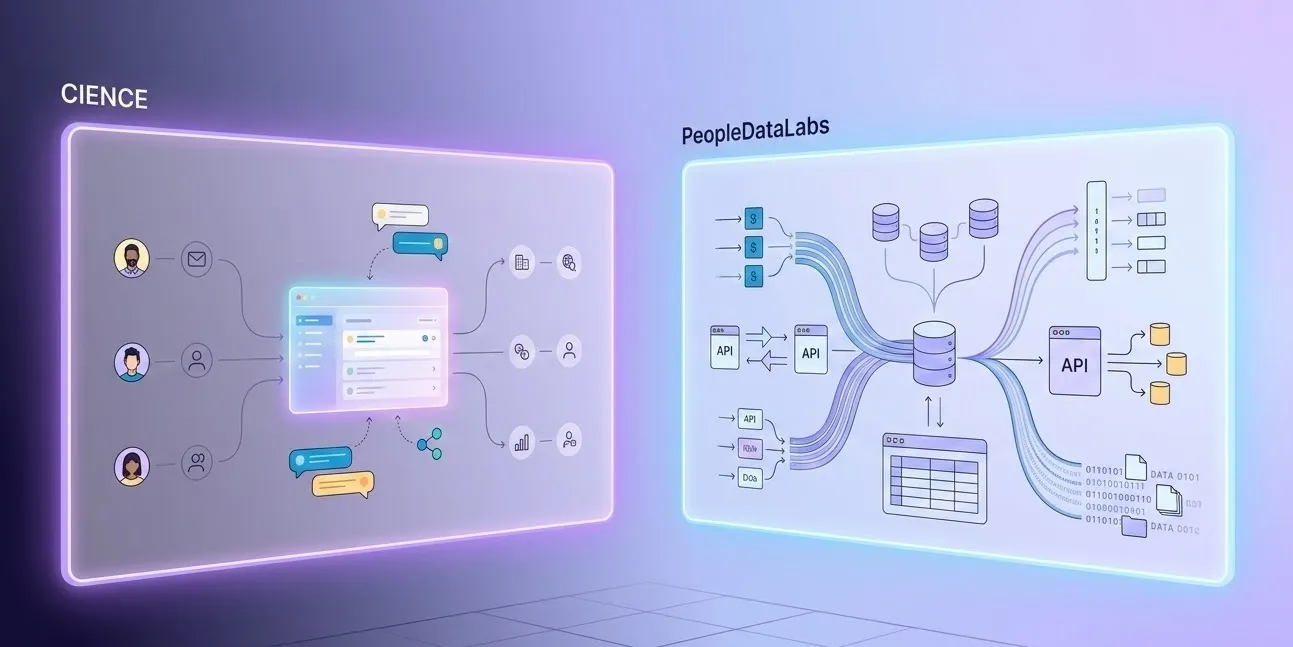

CIENCE and PeopleDataLabs solve different problems in the B2B data ecosystem, even though both operate in prospecting and enrichment.
CIENCE focuses on managed outbound services, human-led research, and sales development support.
PeopleDataLabs provides large-scale, API-first people and company data for developers, recruiters, and data teams.
Comparing CIENCE vs PeopleDataLabs helps sales leaders, RevOps teams, and founders understand whether they need outsourced prospecting execution or raw, programmatic data infrastructure.
Key Takeaways
CIENCE is essentially an outsourced sales department, making it the right move for companies that don't have the time or staff to run their own outbound campaigns. Instead of just giving you a login to a database, they provide the actual humans, SDRs and researchers who do the heavy lifting of finding leads and booking meetings for you.
PeopleDataLabs is a massive data warehouse built specifically for developers and data scientists who want to build their own tools. It doesn't have a "user interface" in the traditional sense; instead, it provides a powerful API that lets you pull billions of data points directly into your own software.
FullEnrich steps in to address the "data silos" that both platforms can create. While CIENCE relies on its internal research and PeopleDataLabs relies on its specific API, FullEnrich runs a "waterfall" search across 20+ different providers at once.
CIENCE vs PeopleDataLabs: Side-by-Side Comparison
Let’s look at this quick comparison to understand how CIENCE and PeopleDataLabs differ in their service models, automation levels, pricing structures, and ideal use cases for modern revenue teams.
Attributes | CIENCE | PeopleDataLabs |
|---|---|---|
Best For | Companies that want outsourced outbound prospecting and managed SDR services | Teams that need large-scale people and company data via API |
Core Focus | Human-led lead research and outbound campaign execution | API-first people and company data enrichment |
Primary Users | Sales leaders, founders, and GTM teams without in-house SDR bandwidth | Developers, data teams, recruiters, RevOps |
Data Source | Human research, proprietary datasets, public sources | Aggregated public web data, proprietary partnerships, structured datasets |
Automation | Moderate; campaign automation with human oversight | High; fully programmatic API-based workflows |
Pricing Model | Contract-based managed service pricing (custom quotes) | Usage-based API pricing starts around $98 per month |
Data Compliance | GDPR and CCPA-aligned processes | GDPR and CCPA are aligned |
Integration | CRM integrations (Salesforce, HubSpot), outbound tools | API integration with CRM, data warehouses, and internal systems |
Support | Dedicated account managers and outbound team | Developer documentation, support tickets, and enterprise support tiers |
What is CIENCE?
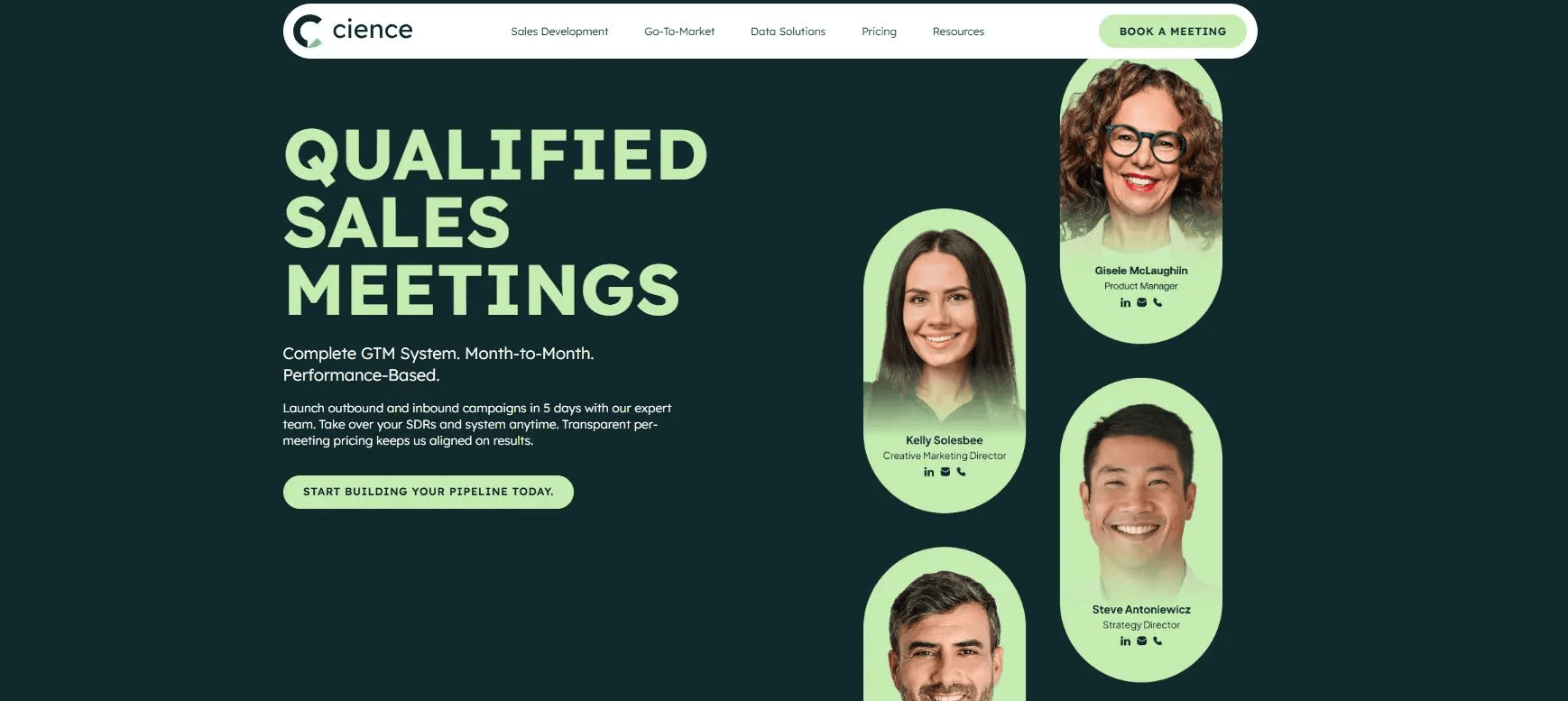
CIENCE is a managed B2B lead generation and outbound sales service that combines human researchers, SDRs, and campaign execution. CIENCE builds target account lists, validates contacts, and runs multi-channel outbound campaigns on behalf of clients.
The platform focuses on outsourced prospecting for companies that lack internal SDR bandwidth or want to generate a pipeline faster. Instead of providing only raw data, CIENCE delivers research-backed leads, email outreach, LinkedIn prospecting, and appointment setting as a bundled service.
What is PeopleDataLabs?
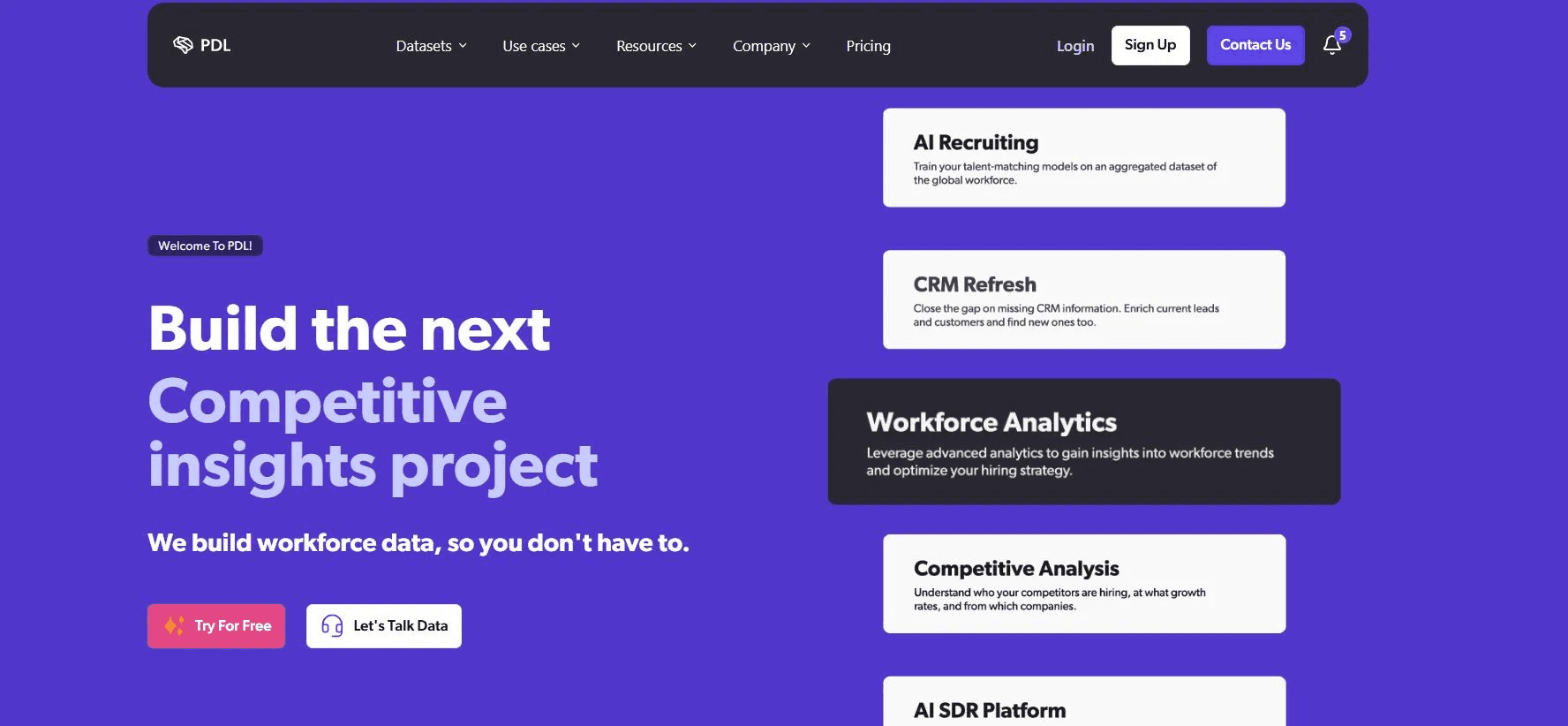
PeopleDataLabs is a B2B data platform that provides large-scale datasets on people and companies through APIs and downloadable data products. PeopleDataLabs enables teams to enrich leads, power recruiting platforms, build analytics models, and integrate data into CRMs or internal systems.
The platform focuses on structured, programmatic access to hundreds of millions of professional profiles and company records. The platform serves technical teams that need scalable enrichment, bulk data access, and automation-ready infrastructure rather than managed outbound services.
What Services Are Offered by CIENCE and PeopleDataLabs?
CIENCE and PeopleDataLabs provide fundamentally different services. CIENCE delivers managed outbound execution with human researchers and SDRs, while PeopleDataLabs delivers structured people and company data through APIs and datasets. Understanding these services helps sales leaders and data teams choose between execution support and data infrastructure.
Services Offered by CIENCE
CIENCE doesn't just sell you a login to a database; they essentially sell you a "sales department in a box." Their services are built for companies that want to outsource the headache of top-of-funnel prospecting, so their internal team can focus strictly on closing deals.
Managed Outbound SDR Teams: This is their flagship service, where they provide a dedicated Sales Development Representative (SDR) who works exclusively for your brand.
Custom Sales Research: Instead of relying on a static database, CIENCE offers a service where human researchers manually build lists based on your specific "Ideal Customer Profile."
Inbound Lead Qualification: This service focuses on the "speed to lead" problem. CIENCE professionals monitor your website and incoming inquiries in real-time to qualify prospects as they arrive.
Services Offered by PeopleDataLabs
PeopleDataLabs (PDL) is a technical powerhouse that provides "data as infrastructure." They don’t offer a dashboard or a managed team; instead, they provide the raw pipes that feed billions of data points into your own applications.
Person and Company Enrichment API: This is their core service that lets you take a single piece of information, like an email or a LinkedIn URL, and instantly retrieve a full profile. This includes a person’s entire work history, skills, education, and even social media links, all delivered in a format your software can understand.
Bulk Data Licensing: For companies that need to build their own internal database from scratch, PDL offers a service to license its entire dataset in bulk. This allows you to host millions of records on your own servers for large-scale analysis, machine learning, or internal search engines.
Identity Resolution Service: This service is designed to solve the "fragmented data" problem. It takes multiple, messy records from different sources and uses advanced matching logic to link them to a single, unique individual.
Search and Discovery API: PDL provides a service that lets you query its entire "Data Lake" using complex logic. You can ask for "every Software Engineer in Berlin who knows Python and has at least 5 years of experience," and the API will return a structured list of every matching profile in seconds.
Also Read: 8 Best People Data Labs Alternatives & Competitors
What Are the Key Features of CIENCE and PeopleDataLabs?
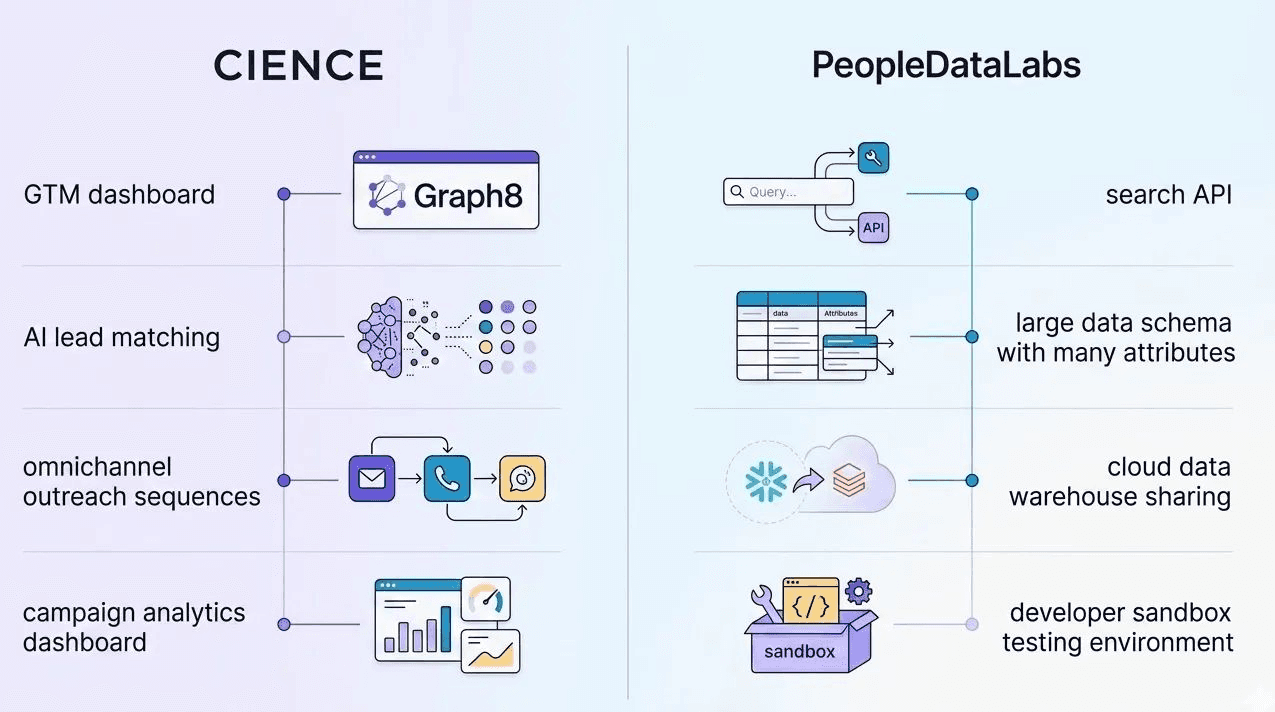
Key features highlight how each platform operates at a product level. CIENCE focuses on oversight of execution, reporting, and managed campaign control. PeopleDataLabs focuses on API performance, data scale, and programmatic flexibility.
Key Features of CIENCE
CIENCE provides a unified software environment, known as Graph8, that serves as the technical backbone for its inbound and outbound operations. These features are designed to give you full visibility into the "human" work being done.
Unified GTM Dashboard (graph8): This is the central command center for tracking every lead, message, and meeting in real-time. It pulls all your sales activity into one view, so you don't have to guess what your outsourced SDRs are doing.
AI-Driven Lead Matching: The platform uses proprietary algorithms to scan millions of records and surface prospects that match your specific "Ideal Customer Profile."
Omnichannel Sequence Builder: This tool allows for the creation of complex outreach workflows that span email, phone, and social media.
Real-Time Campaign Analytics: CIENCE features a deep reporting suite that breaks down exactly which messaging and which channels are booking the most meetings.
Key Features of PeopleDataLabs
PeopleDataLabs is a developer-first toolkit that prioritizes technical flexibility and depth of data. Its features are built for those who want to "plug into" a massive data lake and use it to power their own internal systems, AI models, or custom recruiting tools.
Elasticsearch-Compatible Search API: This feature allows you to query over 2.5 billion records using complex, professional-grade search logic. It’s designed for engineers who need to build "surgical" searches, like finding every VP of Engineering in a specific city who has worked at a Fortune 500 company.
Flexible Data Schema (200+ Fields): Unlike standard databases that only give you a name and email, PDL features an incredibly granular schema. You can pull data on everything from specific skills and education history to past job titles and social media links.
Bulk Snowflake & Databricks Sharing: For companies that don't want to rely on live API calls, PDL features direct data sharing through major cloud warehouses.
Sandbox Testing Environment: PDL provides a dedicated developer portal where you can test your API calls and query structures for free before moving into production.
How Accurate Is the Data from CIENCE & PeopleDataLabs?
Data accuracy impacts pipeline quality, recruiter efficiency, and enrichment reliability. CIENCE and PeopleDataLabs approach accuracy differently: one relies on human validation, while the other relies on structured aggregation and API-based updates.
CIENCE Data Accuracy
CIENCE takes a "people-first" approach to data, which is both its greatest strength and its occasional bottleneck. Because they use actual human researchers to verify leads, the data you get is often highly curated and customized to your specific "Ideal Customer Profile."
However, relying on humans entails a real risk of "human error" and turnover. Some users have noted that if an SDR team changes or targeting instructions aren't followed exactly, lead quality can dip. You aren't just buying a static list; you're buying a research process. While this leads to fewer "bogus" records than a pure scrape, it also means the data isn't instant.
PeopleDataLabs Data Accuracy
PeopleDataLabs (PDL) operates on a completely different scale, prioritizing "depth" and "breadth" over manual curation. They aggregate billions of data points from the public web, giving them a massive reach that is perfect for developers and data scientists. Their accuracy is generally high for "career-path" data, such as where someone went to school or their past five job titles. This technical precision is why they hold a strong 4.3/5 rating on G2, as engineers love having a clean, well-documented API that "just works" for large-scale enrichment projects.
Which Platform Offers the Most Intuitive User Experience?
User experience differs significantly: CIENCE provides a managed service, while PeopleDataLabs offers a self-serve data platform. The experience depends on whether a team wants outsourced execution or technical control.
CIENCE User Experience
CIENCE assigns a dedicated team that handles research, targeting, outreach, and reporting. Sales leaders interact through strategy calls, dashboards, and performance reviews rather than a self-serve interface. Onboarding includes ICP workshops, messaging alignment, and campaign setup. The experience requires minimal technical effort on the client's part because CIENCE manages execution.
PeopleDataLabs User Experience
PeopleDataLabs provides API documentation, dashboards, and structured query tools. Users interact through API calls, filters, and dataset downloads rather than managed campaign support. Onboarding requires developer involvement to integrate enrichment into CRM systems, data warehouses, or applications. The platform prioritizes flexibility, bulk search capabilities, and structured outputs.
Pricing Plans
When it comes to budgeting for these two, you are looking at completely different financial philosophies. One is a major investment in a managed team that acts as an extension of your company, while the other is a technical utility that lets you pay only for the specific data points you pull.
CIENCE Pricing Plans
Because CIENCE provides a managed service rather than just a software login, they don't list a "buy it now" price on their website. Everything is custom-quoted based on the number of SDRs you need and the complexity of your market. However, third-party industry reports give us a very clear idea of the typical investment required.
For a fully managed outbound service, you should expect to pay between $3,000 and $15,000+ per month. If you are just looking for access to their software and data tools, such as CIENCE GO, the platform access usually ranges from $2,400 to $2,900. It is also important to note that CIENCE typically doesn't do "month-to-month" trials; most agreements are 6 to 12-month contracts.
PeopleDataLabs Pricing Plans
PeopleDataLabs follows the classic "developer-friendly" model. They want you to test the pipes before you commit to the big water bill. Their plans are structured to grow alongside your application, from the first line of code to enterprise-scale data warehouses.
Testing APIs: This is the ultimate "sandbox" for developers. You get 100 monthly records for free, so you can test the API integration and see the data schema without spending a dime.
Full APIs (Pro Plan - $98/month): You get a starter pack of 350 monthly records and, more importantly, access to the "premium" fields. This includes high-value data such as direct emails, mobile phone numbers, and full contact dossiers that aren't available in the free tier.
Bulk Data (Enterprise Plan): This is where you get into custom pricing. This tier is for companies that aren't just making a few calls but are downloading millions of records to power their own internal platforms. It comes with a dedicated success team and enterprise security features such as SSO and SAML to keep your data operations compliant and secure.
Also Read: People Data Labs Pricing & Plans (2026): Is it worth it?
Who Should Use CIENCE vs. People Data Labs?
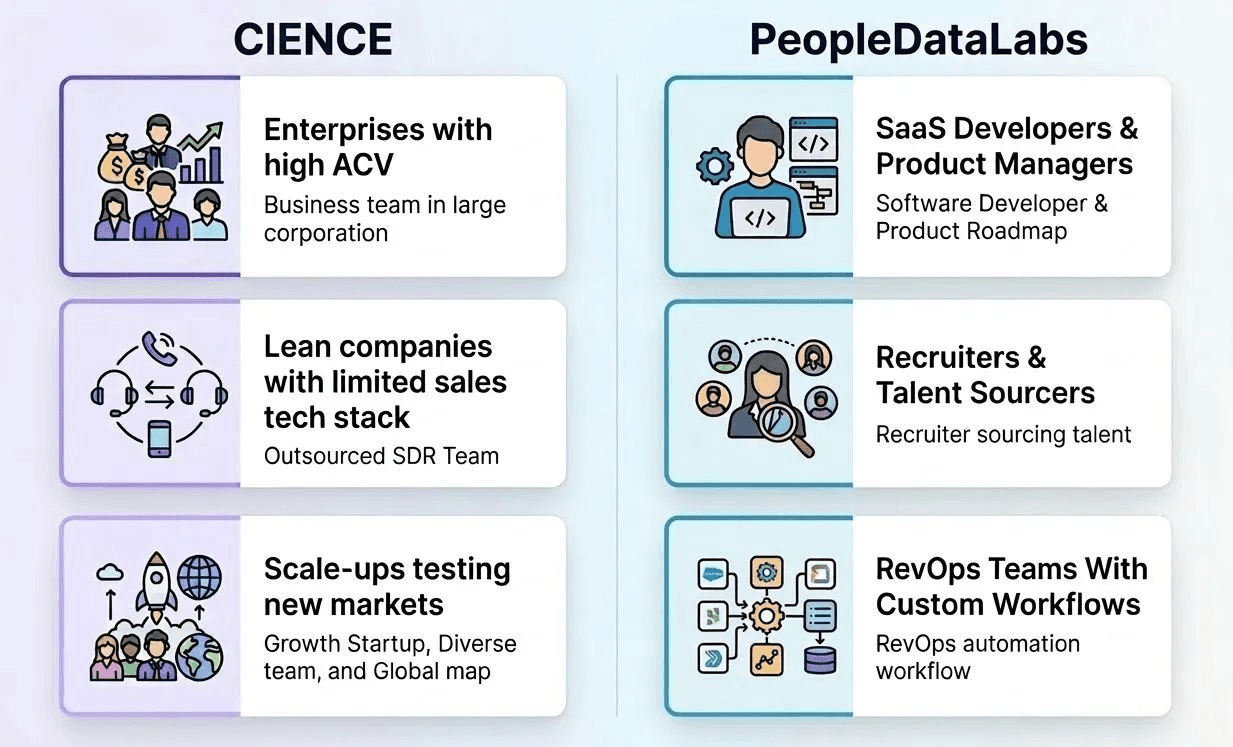
The real question isn't which tool is better, but what you actually want to spend your day doing. One is a service that pays a team to handle the "grunt work" of sales, while the other is a massive data pipe for people who want to build their own internal systems.
Who Should Use CIENCE?
CIENCE is built for companies that want to hit the ground running with outbound sales but don't want to hire, train, and manage an internal team of SDRs. It’s for the "results-oriented" leader who values their time over technical control.
Companies with Large Average Contract Values (ACV): Because the service can cost $3,000 to $15,000 a month, it makes the most sense for businesses selling high-ticket items, where one or two closed deals a year can pay for the entire service.
Organizations without an In-House Sales Stack: If you don't want to buy five different software subscriptions for sequencing, data, and tracking, CIENCE's graph8 platform gives you everything in one place, alongside the staff to run it.
Scale-Ups Testing New Markets: If you want to see if your product resonates in a new industry or country, you can "rent" a CIENCE team for six months to test the waters before committing to permanent internal hires.
Who Should Use People Data Labs?
People Data Labs (PDL) is for the "builders." It is designed for those with a clear technical vision who need a massive, reliable stream of data to fuel their internal platforms, recruiting tools, or AI models.
SaaS Developers & Product Managers: If you are building the next big HR-tech or Sales-tech tool, you use PDL’s API to pull in millions of profiles so your users have a "pre-populated" world to work in.
Recruiters & Talent Sourcers at Scale: Best for high-volume agencies that need to "scrape" the entire professional web for niche talent (like Python developers in Berlin) without manually clicking through every profile on social media.
RevOps Leaders with Custom Workflows: If you already have a complex internal system and just need a "plug-in" that automatically enriches every new lead that hits your CRM.
Pros and Cons of CIENCE vs PeopleDataLabs
Evaluating pros and cons helps teams align platform capabilities with business needs, technical resources, and growth goals.
Pros and Cons of CIENCE
CIENCE is the ultimate choice if you’re looking to offload the entire prospecting headache to a professional team that lives and breathes outbound.
Pros
Human-validated leads: Ensures high-quality contacts aligned with ICP.
Multi-channel outreach: Email, LinkedIn, and call campaigns included.
Managed service: Minimal technical effort required; CIENCE handles execution.
Performance tracking: Dashboards provide metrics on replies, meetings, and campaign ROI.
Scalable for startups/mid-market: Can expand SDR support as needed.
Cons
Higher cost: Enterprise-level retainers may not suit smaller budgets.
Limited self-serve flexibility: Less control over targeting or execution workflows.
Dependent on CIENCE capacity: Campaign speed depends on team availability.
Pros and Cons of People Data Labs
People Data Labs is a dream for technical teams who want to build their own bespoke data world without any "fluff" or middleman.
Pros
Scalable data access: Provides hundreds of millions of professional and company records.
Programmatic enrichment: Integrates with CRM, analytics, and internal workflows.
Flexible filtering: Search by title, industry, seniority, location, or company attributes.
Real-time API queries: Enable dynamic enrichment without manual intervention.
European and global coverage: Structured and normalized data for multiple regions.
Cons
Technical setup required: API integration needs developer resources.
No managed outreach: Teams handle targeting, campaign execution, and lead follow-up themselves.
Data accuracy varies by region: Some regions may have less verified information.
Which One Is a Better Option?
CIENCE is better for companies that want human-validated leads, multi-channel outreach, and appointment setting without building internal SDR teams. Its strength lies in delivering qualified meetings and consistently generating a pipeline through managed campaigns.
PeopleDataLabs is ideal for technical teams that need large-scale datasets on people and companies for enrichment, analytics, and custom workflows. It offers API-driven access to hundreds of millions of professional records, giving flexibility and scale but requiring technical implementation.
For teams that want reliable, multi-source contact and company enrichment without hiring SDR agencies or building complex data pipelines, FullEnrich provides over 20 provider waterfall enrichment with a pay-for-results model. This makes it a practical middle ground between outsourced execution and pure API-based enrichment.
Frequently Asked Questions (FAQs)
Which platform is better for outbound lead generation?
CIENCE is best for outbound lead generation because it combines human researchers, SDR execution, and multi-channel outreach. PeopleDataLabs focuses on providing raw, programmatic data for enrichment, not on campaign execution.
Which platform is easier for non-technical teams?
CIENCE requires minimal technical effort; all prospecting, research, and outreach are handled by the managed service team. PeopleDataLabs requires developer resources for API integration and workflow setup.
How accurate is the data from each platform?
CIENCE relies on human-verified leads and manually validated contacts. PeopleDataLabs relies on aggregated, structured datasets; accuracy is high but can vary by region or data availability.
Are these platforms scalable for larger teams?
Yes. CIENCE scales by adding SDRs or expanding campaign volume. PeopleDataLabs scales programmatically with API calls, dataset size, and integration points.
What are the pricing expectations?
CIENCE pricing is contract-based, typically enterprise-level retainers for managed campaigns. PeopleDataLabs starts at $98–$199 per month for small-scale API access, with enterprise pricing for high-volume usage.
Can these platforms integrate with CRMs or other tools?
CIENCE integrates with Salesforce, HubSpot, and campaign tracking tools for reporting. PeopleDataLabs offers API access to connect with CRMs, data warehouses, or internal analytics systems.
Which platform is better for recruiters?
PeopleDataLabs is better suited for recruiters needing verified contact and company data at scale. CIENCE is more focused on outbound sales campaigns than recruiting.
Is there an alternative that provides reliable multi-source enrichment without managed services?
Yes. FullEnrich provides multi-provider enrichment in a pay-for-results model, offering verified data without requiring SDR campaigns or technical API implementation.



Other Articles
Cost Per Opportunity (CPO): A Comprehensive Guide for Businesses
Discover how Cost Per Opportunity (CPO) acts as a key performance indicator in business strategy, offering insights into marketing and sales effectiveness.
Cost Per Sale Uncovered: Efficiency, Calculation, and Optimization in Digital Advertising
Explore Cost Per Sale (CPS) in digital advertising, its calculation and optimization for efficient ad strategies and increased profitability.
Customer Segmentation: Essential Guide for Effective Business Strategies
Discover how Customer Segmentation can drive your business strategy. Learn key concepts, benefits, and practical application tips.