
Most revenue leaders treat these titles as interchangeable, but assigning the wrong pre-sales expert to a complex deal will actively kill your win rate. If buyers are stalling because they cannot see a clear return on investment, you need a Solutions Consultant. This role maps your product directly to the buyer's business context.
Conversely, if deals are falling apart during strict security reviews or IT integration tests, pitching high-level business value will not save you. That is where the Sales Engineer steps in. They strip away the marketing narrative to focus entirely on technical validation and risk removal. Operating in the weeds with developers and IT directors, the Sales Engineer proves that your system's architecture will safely integrate into the client's existing tech stack.
Key Takeaways
A Solutions Consultant is your primary engine for storytelling, focusing on the "Why" to get executive buy-in through ROI and business workshops. Conversely, the Sales Engineer is the technical gatekeeper who proves the "How," focusing on deep product architecture and system validations to satisfy IT teams.
Solutions Consultants typically lead the early-to-mid stages of a deal, shaping the buyer’s vision and aligning the product with their strategic goals. Sales Engineers generally enter during the mid-to-late stages, where the conversation shifts from high-level benefits to rigorous security reviews, API testing, and risk removal.
Solutions Consultant vs Sales Engineer: Side-by-Side Comparison
This comparison illustrates the critical divide between business alignment and technical infrastructure. While both roles are essential for closing complex deals, the Solutions Consultant is your primary engine for proving the financial and operational "Why" to executive stakeholders.
Attribute | Solutions Consultant | Sales Engineer |
|---|---|---|
Core focus | Solutions Consultant explains business value | Sales Engineer proves technical fit |
Main goal | Solutions Consultant helps buyers understand “why” | Sales Engineer helps buyers confirm “how” |
Primary buyer | A Solutions Consultant works with business leaders | A Sales Engineer works with technical teams |
Sales stage involvement | Solutions Consultant joins early and mid stages | Sales Engineer joins mid and late stages |
Technical depth required | A Solutions Consultant needs moderate product knowledge | A Sales Engineer needs deep product knowledge |
Business knowledge required | A Solutions Consultant needs a strong business understanding | A Sales Engineer needs a basic business context |
Daily work type | Solutions Consultant runs calls and workshops | The Sales Engineer runs validations and tests |
The tools used most | Solutions Consultant uses CRM and demo tools | The Sales Engineer uses the product and testing tools |
Career background fit | Solutions Consultant fits sales or consulting paths | Sales Engineer fits engineering or technical paths |
Who should choose this role | Solutions Consultant fits strong communicators | Sales Engineer fits problem solvers |
What does a Solutions Consultant do?
A Solutions Consultant defines business problems, translates them into actionable solutions, and guides buyers through the decision-making process. A Solutions Consultant owns business discovery, aligns stakeholders, and validates use cases.
Solutions Consultant solves challenges that slow deal progress or confuse buyers
Discovery ownership: Solutions Consultant uncovers buyer pain points and priorities to map solutions effectively.
Business requirement mapping: Solutions Consultant translates organizational needs into product-fit scenarios.
Stakeholder alignment: The Solutions Consultant ensures all decision-makers understand the solution's value and implications.
Use-case validation: Solutions Consultant confirms that the proposed solutions align with real-world buyer challenges.
Where in the funnel does a Solutions Consultant operate?
Solutions Consultant engages at multiple stages but focuses on business alignment rather than technical validation:
Pre-sales: Solutions Consultant guides discovery calls and identifies buyer needs.
Mid-funnel: Solutions Consultant designs demos, builds use-case narratives, and aligns stakeholders on value.
Post-demo: Solutions Consultant supports business discussions, answers value questions, and prepares the account for technical handoff.
Collaboration with Account Executives: Solutions Consultant works alongside Account Executives, providing clarity on business problems, demo strategy, and buyer alignment while leaving deal ownership with the sales lead.
What does a Sales Engineer do?
The Sales Engineer ensures technical feasibility, confirms product fit, and mitigates technical risks throughout the sales process. The Sales Engineer supports Account Executives by validating solutions, addressing technical concerns, and executing proof-of-concept tests.
The Sales Engineer addresses technical barriers that could prevent deal closure:
Technical validation: The Sales Engineer confirms that the product functions as required within the buyer's systems.
Architecture alignment: The Sales Engineer ensures the product integrates with the existing IT infrastructure.
Security and compliance responses: Sales Engineer answers security, privacy, and regulatory questions to reduce risk.
Proof-of-concept execution: The Sales Engineer demonstrates a real-world implementation to validate feasibility and performance.
Where does a Sales Engineer operate in the funnel?
Sales Engineer engages primarily in the mid-to-late stages where technical clarity drives decisions:
Late-stage deal support: Sales Engineer resolves remaining technical objections and confirms implementation readiness.
Enterprise and technical buyer involvement: Sales Engineer communicates directly with IT, architects, and product teams to validate integration and scalability.
Procurement and IT alignment: Sales Engineer ensures contractual, compliance, and technical requirements are met before final approval.
How responsibilities differ between Solutions Consultants and Sales Engineers
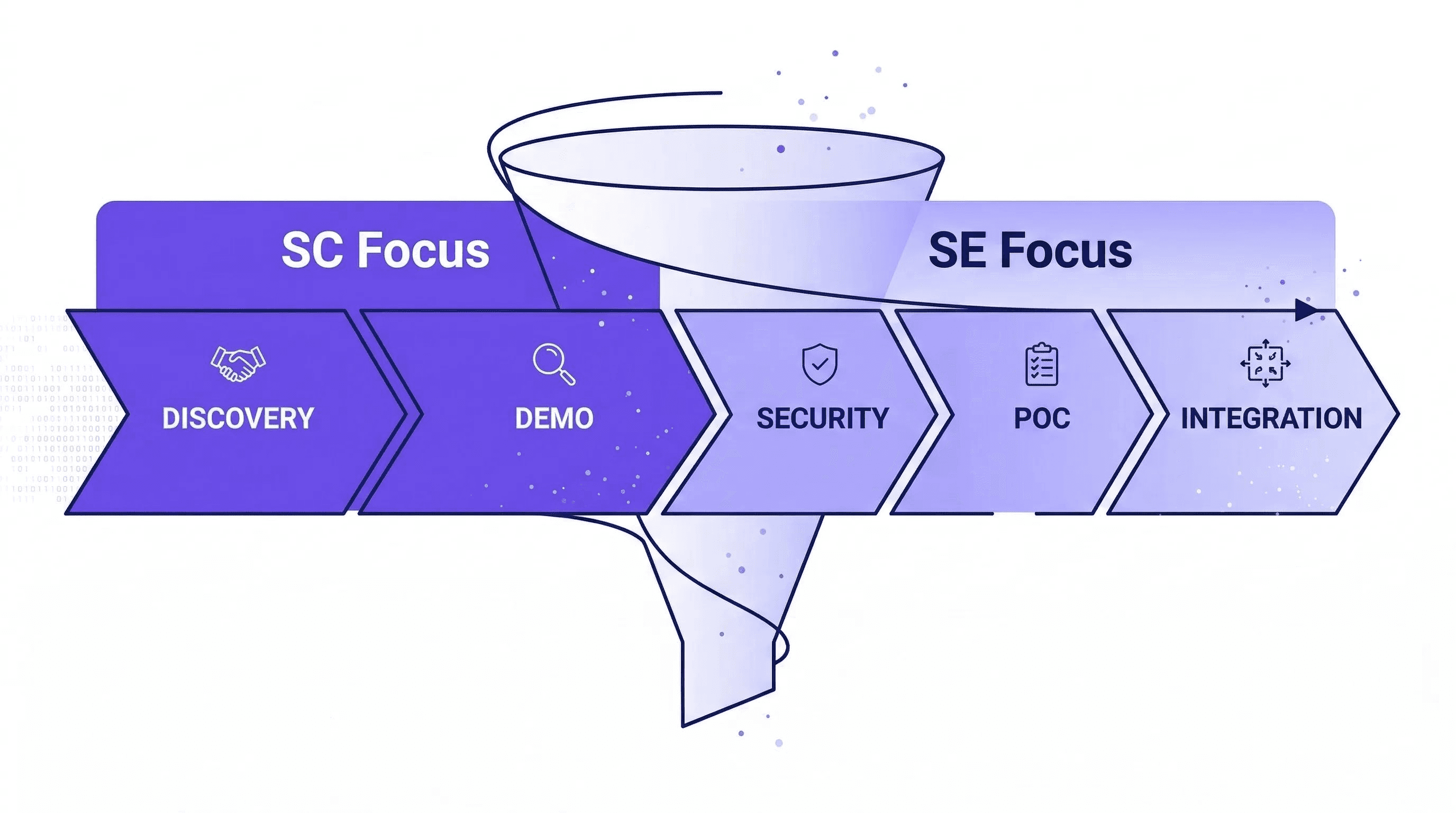
Solutions Consultants and Sales Engineers focus on different areas of execution to drive sales efficiency. Solutions Consultants emphasize business clarity, stakeholder alignment, and demonstration of value. Sales Engineers emphasize technical validation, integration feasibility, and risk mitigation. Understanding their distinct responsibilities ensures smooth collaboration and higher deal conversion rates.
Daily Responsibilities of a Solutions Consultant
Solutions Consultant leads discovery calls to uncover buyer priorities and pain points, then documents use cases that map organizational needs to product capabilities. Solutions Consultant designs demo narratives that emphasize business value, efficiency gains, and ROI. The Solutions Consultant ensures that every interaction communicates measurable impact, aligns decision-makers, and clarifies the solution fit before technical evaluations begin.
Also Read: Senior Solutions Consultant VS Solutions Consultant
Daily responsibilities of a Sales Engineer
Sales Engineer conducts technical demos to validate product functionality against buyer requirements, demonstrating integrations, APIs, and system compatibility. Sales Engineer answers security, compliance, and regulatory questions to remove risk, while configuring custom solutions to meet enterprise workflow needs. The Sales Engineer ensures that every technical concern is addressed, the proof of concept succeeds, and the product aligns with the buyer's IT architecture.
What Skills matter more for a Solutions Consultant
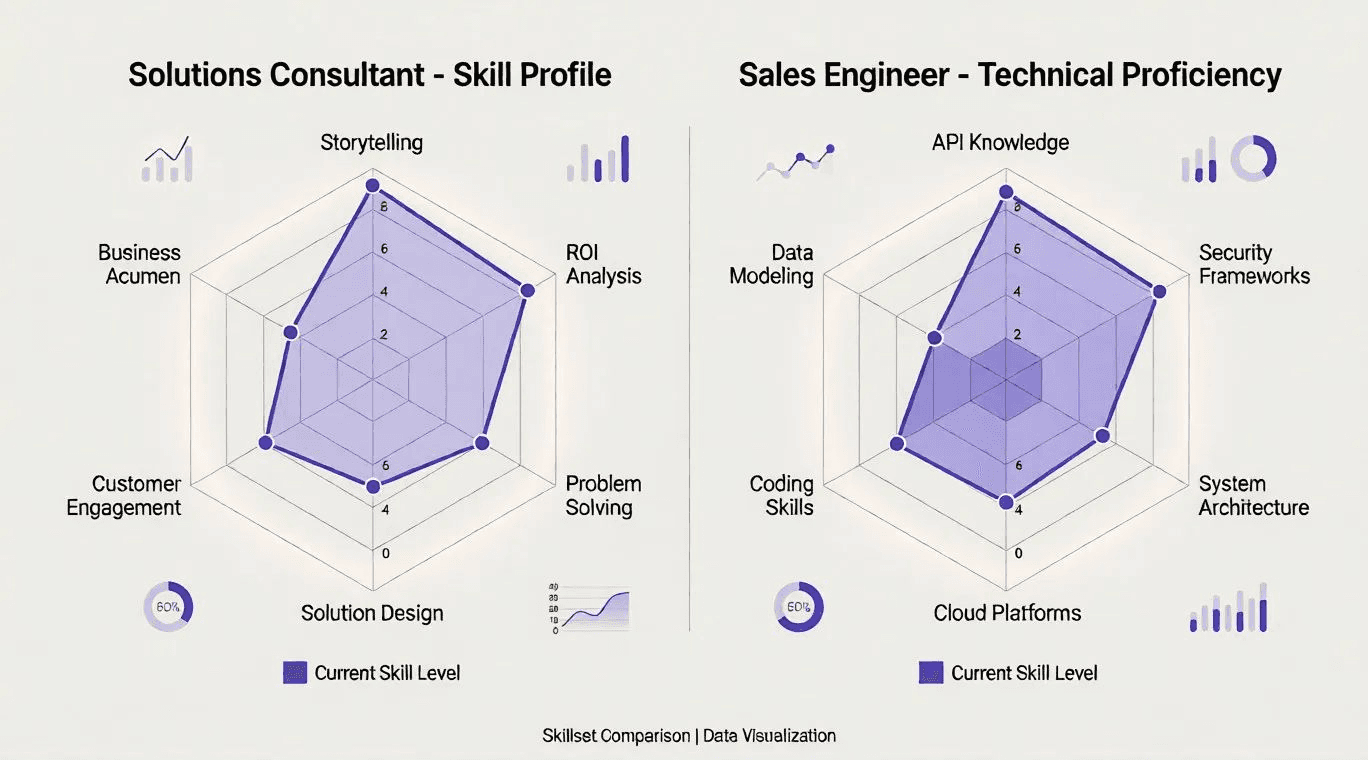
A Solutions Consultant requires a mix of business, communication, and light technical skills to guide buyers and support Account Executives. Key skills include:
Communication skills: Clearly explain product value, ROI, and efficiency gains to multiple stakeholders.
Business analysis: Interpret organizational processes, identify gaps, and map solutions to buyer needs.
Storytelling with data: Turn metrics, case studies, and outcomes into persuasive narratives that influence decision-makers.
Stakeholder management: Align executives, department leads, and cross-functional teams, resolving conflicts and building consensus.
Light technical literacy: Understand product features, basic integrations, and workflow feasibility to collaborate effectively with Sales Engineers.
What Skills matter more for a Sales Engineer
Sales Engineer requires deep technical expertise, problem-solving ability, and execution focus to ensure solutions work in real-world buyer environments. These skills reduce technical risk, improve deal confidence, and enable successful enterprise implementations.
Systems architecture knowledge: The Sales Engineer understands the buyer's IT infrastructure, system dependencies, and integration constraints to validate the solution's fit.
APIs and integrations: Sales Engineer configures and demonstrates product connectivity with other tools, ensuring seamless workflow compatibility.
Security frameworks: Sales Engineer addresses security, compliance, and regulatory requirements, mitigating technical and legal risks in complex deals.
Product configuration: The Sales Engineer customizes solutions to align with buyer workflows, including settings, modules, and deployment scenarios.
Troubleshooting under deal pressure: A Sales Engineer resolves technical issues during demos, proof-of-concept sessions, or late-stage evaluations to prevent deal stalls.
Also Read: Head of Sales Engineering VS Senior Sales Engineer
How Career Paths Differ for Solutions Consultants and Sales Engineers
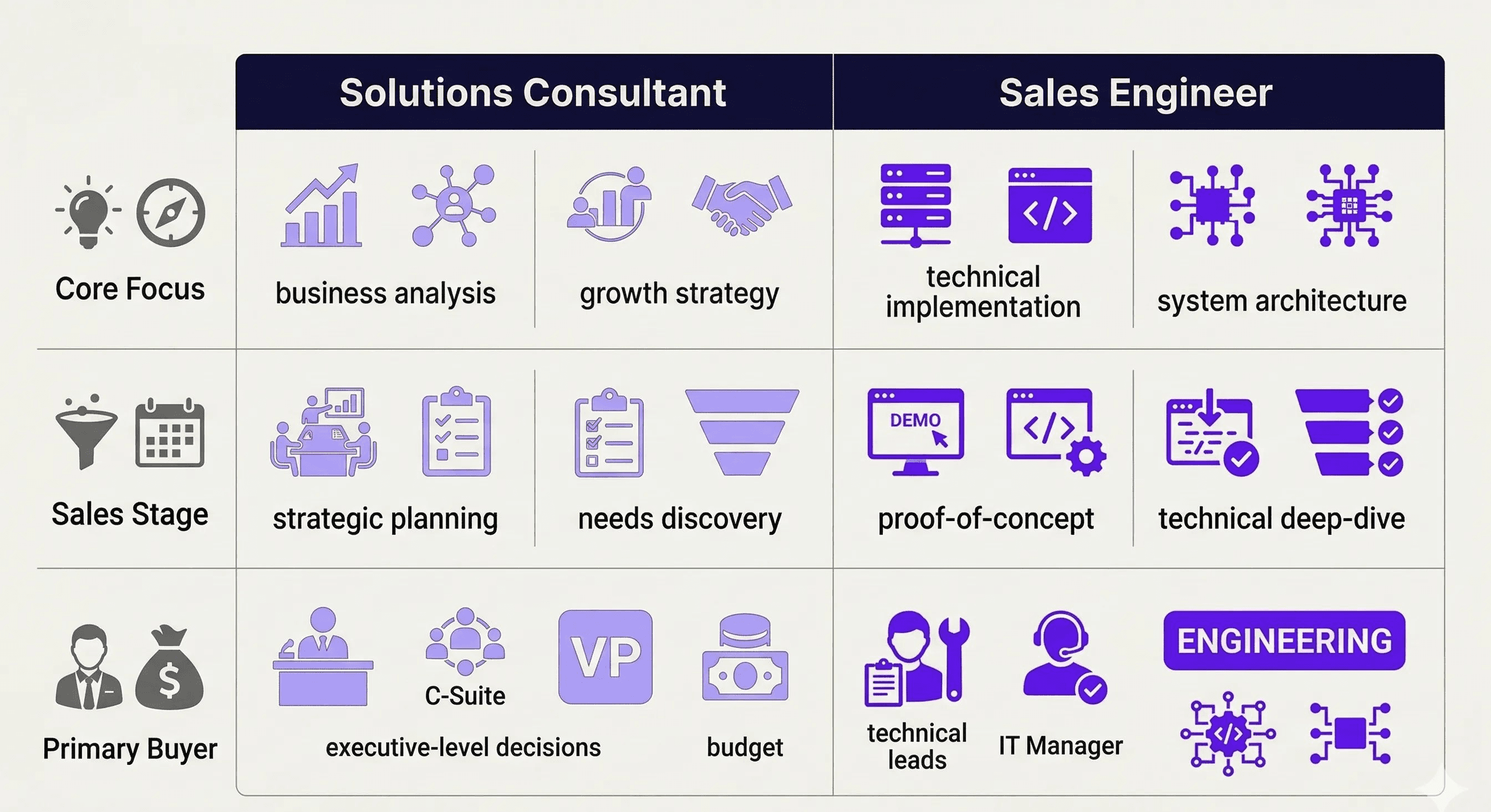
Solutions Consultants and Sales Engineers follow distinct career trajectories based on their core focus. Solutions Consultants progress through business-aligned roles emphasizing strategy, customer impact, and sales enablement. Sales Engineers progress through technical, execution-focused roles that emphasize architecture, implementation, and technical leadership.
Typical career path for a Solutions Consultant
Solutions Consultant career growth emphasizes business strategy, client impact, and revenue enablement. Professionals often advance from Solutions Consultant → Senior Solutions Consultant → Principal Consultant.
Many transition into Sales Enablement, training sales teams on value articulation, or Product Marketing, shaping messaging and positioning based on field insights. Some move into Revenue Operations, leveraging experience in discovery, demos, and business alignment to optimize sales processes, KPIs, and technology adoption. Career progression rewards strategic thinking, communication, and cross-functional collaboration.
Typical career path for a Sales Engineer
Sales Engineer career growth emphasizes technical expertise, solution architecture, and enterprise deal support. Professionals often advance from Sales Engineer → Senior Sales Engineer → Principal Sales Engineer. Many transition into Solutions Architect roles, designing scalable customer solutions, or into Technical Product Manager roles, bridging product strategy with technical feasibility.
Some reach Engineering leadership, managing technical teams, integrations, and product implementation strategy. Career progression rewards technical depth, problem-solving, and the ability to simplify complex solutions for buyers.
Which Role Works more Closely with Account Executives?
Solutions Consultants and Sales Engineers collaborate with Account Executives (AEs) to support deal progression, but their interactions and ownership differ. Clear role boundaries prevent overlap, reduce friction, and ensure deals move efficiently through the pipeline.
A Solutions Consultant works closely with AEs during the early and mid-funnel stages, owning discovery calls, use-case documentation, and demo-narrative design. Solutions Consultant ensures business value is clear to stakeholders, enabling AEs to focus on deal strategy and closing. Sales Engineer collaborates with AEs primarily in mid-to-late stages, handling technical validation, integration feasibility, and proof-of-concept execution.
Conflict points often arise when responsibilities are unclear, for example, if a Solutions Consultant steps into technical demonstrations or a Sales Engineer tries to influence business prioritization. Best-practice team structures separate responsibilities: Solutions Consultant owns business clarity and demo storytelling, Sales Engineer owns technical validation, and AEs coordinate overall deal strategy.
Which Role do Companies hire first as they scale?
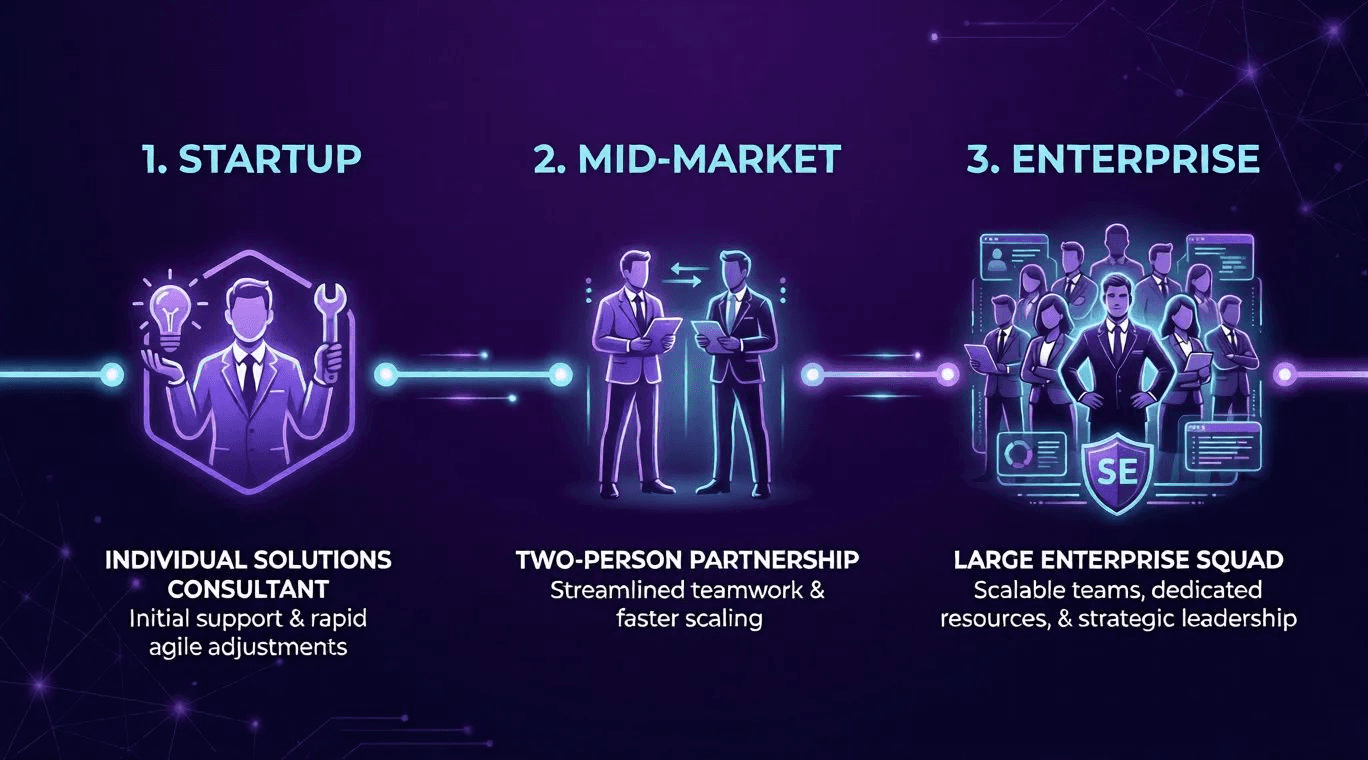
Companies prioritize Solutions Consultants or Sales Engineers differently depending on stage, deal complexity, and buyer needs. Early hires shape sales efficiency, deal velocity, and technical credibility as organizations grow.
Early-stage startups: Companies often hire a Solutions Consultant first because discovery, buyer alignment, and clear value messaging are critical for securing initial customers. Solutions Consultant helps AEs qualify opportunities, craft demos, and articulate business outcomes without requiring deep technical validation.
Mid-market scaling: Companies hire Sales Engineers alongside Solutions Consultants. The Solutions Consultant continues to drive business clarity, while the Sales Engineer handles technical evaluations, integration feasibility, and proof-of-concept execution.
Enterprise organizations: Hiring emphasises Sales Engineers due to complex technical environments, security reviews, and multi-departmental integrations. Solutions Consultants remain valuable for business storytelling, but technical validation and architecture alignment become essential to close high-value deals.
Tools used by Solutions Consultants
Solutions Consultants rely on business-focused tools to streamline discovery, craft compelling demos, and provide buyers with clear insights. These tools reduce preparation time, improve stakeholder alignment, and ensure every interaction demonstrates measurable value.
CRM systems: Solutions Consultants use platforms such as Salesforce, HubSpot, and Microsoft Dynamics to track deals, manage contacts, and record discovery insights, ensuring sales teams have a single source of truth.
Demo platforms: Solutions Consultants leverage tools such as Demodesk or Walnut to create interactive, scenario-based product demos that clearly highlight business outcomes.
Documentation tools: Solutions Consultants maintain structured notes, use-case templates, and workshop summaries using Confluence, Notion, or Google Workspace, providing clarity to both buyers and internal teams.
Data enrichment and prospect context tools: Solutions Consultants use platforms such as LinkedIn Sales Navigator and Full Enrich (which offers 50 Free leads) to gather actionable buyer insights, company context, and organizational structure.
Tools used by Sales Engineers
Sales Engineers rely on technical tools to validate solutions, ensure integration compatibility, and mitigate implementation risks. These tools help Sales Engineers demonstrate feasibility, resolve technical objections, and build buyer confidence before purchase.
Sandbox environments: Sales Engineers use isolated test environments to simulate buyer workflows, test configurations, and validate product behavior without impacting live systems.
API testing tools: Sales Engineers leverage Postman, SoapUI, or similar platforms to verify integrations, confirm data flows, and troubleshoot connectivity between products and buyer systems.
Security documentation platforms: Sales Engineers maintain compliance and security records using platforms such as Drata, Vanta, or internal repositories, ensuring that regulatory requirements and buyer concerns are addressed.
Product telemetry and logs: Sales Engineers analyze telemetry and logs to diagnose issues, optimize configurations, and verify system performance in real time or during proof-of-concept testing.
Common misconceptions about Solutions Consultants and Sales Engineers
Misunderstandings about Solutions Consultants and Sales Engineers often create role confusion, overlap, and inefficiencies. Clarifying misconceptions helps organizations hire correctly, define ownership, and optimize deal outcomes.
“Both roles are the same” – Solutions Consultants focus on business discovery, use-case validation, and demo storytelling, while Sales Engineers focus on technical validation, integrations, and proof-of-concept execution. Their skill sets, responsibilities, and deal impact are distinct.
“One role fits all company stages” – Startups often prioritize Solutions Consultants for business clarity, while enterprise deals require Sales Engineers for technical validation and complex integrations. Each stage demands different expertise to maximize deal velocity and minimize risk.
Job Market Demand and Growth Projections
The demand for both Solutions Consultants and Sales Engineers is high. It continues to grow, driven by the increasing complexity of technology solutions and the need for technical expertise in sales. According to the U.S. Bureau of Labor Statistics, the job market for these roles is expected to grow by around 6% from 2024 to 2034.
Which Job Role is Better?
Solutions Consultants and Sales Engineers play distinct but complementary roles in revenue teams. Solutions Consultants focus on business alignment, discovery, and value articulation, while Sales Engineers focus on technical validation, integrations, and risk mitigation.
Clear role definition, collaboration with Account Executives, and the right tooling accelerate deals, improve stakeholder confidence, and support long-term career growth. Professionals choosing a career path should assess their strengths in communication, business analysis, or technical problem-solving to align with a role that maximizes impact and career progression.
Frequently Asked Questions (FAQs)
Can a Solutions Consultant become a Sales Engineer?
Yes, professionals with strong business acumen can transition. Still, they need to build deep technical knowledge, learn to integrate, and gain experience executing proofs of concept to succeed as a Sales Engineer.
Do Sales Engineers carry a quota?
Typically, Sales Engineers do not carry full revenue quotas. Their compensation often includes bonuses tied to deal success, technical milestone completion, or enterprise deal closures rather than direct sales targets.
Which role is more technical?
Sales Engineers are more technical, handling system architecture, APIs, integrations, and troubleshooting, while Solutions Consultants focus on business value, discovery, and storytelling.
Which role earns more long-term?
Sales Engineers generally have higher OTEs due to technical specialization and involvement in enterprise deals, while Solutions Consultants earn slightly lower but stable compensation with business-aligned incentives.
Which role is better for founders transitioning into sales?
Founders often align better with Solutions Consultant roles because business strategy, use-case mapping, and stakeholder alignment leverage entrepreneurial skills more than deep technical execution.
Can one person perform both roles effectively?
Some early-stage startups combine both roles in one person. However, as deals scale, separating business and technical responsibilities improves efficiency, reduces and increases win rates.
How do these roles collaborate in enterprise deals?
Solutions Consultants handle stakeholder alignment, use-case validation, and demo storytelling, while Sales Engineers handle technical validation, integration feasibility, and security or compliance questions, creating a seamless buyer experience.
What skills make a candidate stand out for both roles?
Strong communication, analytical thinking, stakeholder management, and adaptability are valuable for Solutions Consultants. Technical depth, problem-solving, system knowledge, and the ability to troubleshoot under pressure are critical for Sales Engineers.
Are these roles evolving in 2026?
Yes, Solutions Consultants increasingly rely on data-driven insights and enrichment tools such as Full Enrich. At the same time, Sales Engineers leverage sandbox environments, telemetry, and API testing to support complex enterprise deals more quickly.
Which role has faster career progression?
Progression depends on skills and focus: Solutions Consultants can move into Sales Enablement, Product Marketing, or Revenue Operations, while Sales Engineers can advance into Solutions Architect, Technical Product Manager, or Engineering Leadership roles.



Other Articles
Cost Per Opportunity (CPO): A Comprehensive Guide for Businesses
Discover how Cost Per Opportunity (CPO) acts as a key performance indicator in business strategy, offering insights into marketing and sales effectiveness.
Cost Per Sale Uncovered: Efficiency, Calculation, and Optimization in Digital Advertising
Explore Cost Per Sale (CPS) in digital advertising, its calculation and optimization for efficient ad strategies and increased profitability.
Customer Segmentation: Essential Guide for Effective Business Strategies
Discover how Customer Segmentation can drive your business strategy. Learn key concepts, benefits, and practical application tips.